
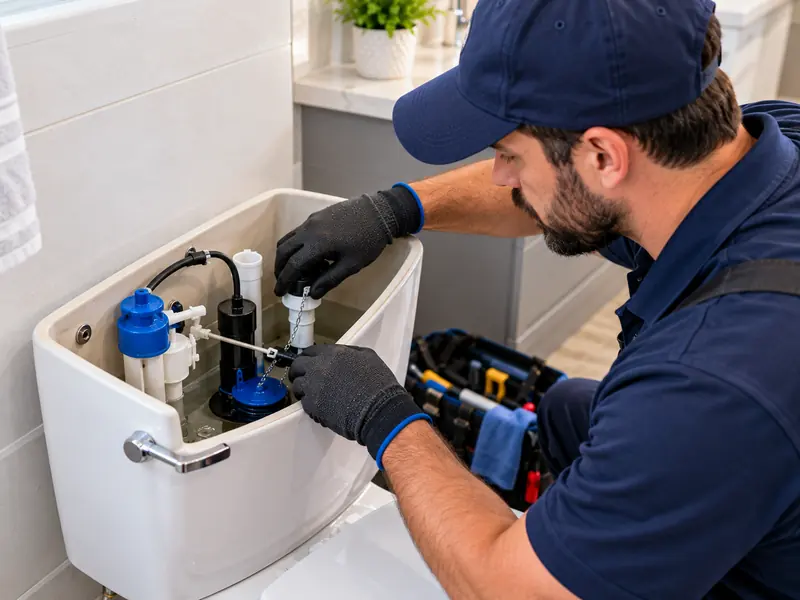
Short answer: A running toilet is almost always caused by one of four parts inside the tank: a warped or mineral-coated flapper, a fill valve that won’t shut off, a float set too high so water spills into the overflow tube, or a tangled or tight flapper chain. Most running toilets are repaired by replacing or adjusting tank components — not by replacing the toilet.
Signs Your Toilet Is Running
Not every running toilet is loud. Watch for these symptoms:
- Water keeps flowing into the bowl long after the flush ends
- The tank refills briefly on its own every few minutes or hours (a “phantom flush”)
- A faint hiss or trickle you can hear from another room at night
- Water level in the tank sits above the top of the overflow tube
- You have to jiggle the handle to make the water stop
- Your water bill rose with no change in household use
According to the EPA’s WaterSense program, a running toilet can waste roughly 200 gallons of water a day. In Whittier, that water is billed by your provider — the City of Whittier Water Department, Suburban Water Systems, or San Gabriel Valley Water Company, depending on your address.
What Makes a Toilet Keep Running
Worn or warped flapper
The flapper is the rubber seal at the bottom of the tank. Over time chlorine, mineral deposits and age harden the rubber so it no longer seals against the flush valve seat. Water seeps into the bowl, the tank level drops, and the fill valve turns on to top it up — the classic phantom flush.
Fill valve that won’t shut off
The fill valve (sometimes called a ballcock on older toilets) refills the tank after each flush. Debris, scale or a worn seal can stop it from closing, so water keeps entering the tank and spills down the overflow tube.
Float set too high
If the float cup or float ball is adjusted too high, the water level rises above the overflow tube before the fill valve shuts off. Most tanks have a fill line marked inside; water should normally stop about an inch below the top of the overflow tube.
Chain problems
A chain with too little slack holds the flapper slightly open. Too much slack can get trapped under the flapper. Either one keeps the toilet running.
Damaged flush valve seat or overflow tube
If the seat the flapper rests on is pitted or cracked, a new flapper won’t seal. A cracked overflow tube can also drain the tank continuously. These usually call for a flush valve repair kit or a full flush valve replacement, which may require separating the tank from the bowl.
Dealing with this right now? Call (562) 245-5818 and get it fixed.
Call Now (562) 245-5818A Quick Check You Can Do First
These steps are safe for most homeowners and help a plumber diagnose the problem faster:
- Dye test: Put a few drops of food coloring in the tank. Don’t flush. If color shows up in the bowl within 15 minutes, the flapper or flush valve is leaking.
- Check the water level: Lift the lid. If water is pouring into the overflow tube, the fill valve or float is the likely cause.
- Look at the chain: It should have a little slack — not tight, not bunched under the flapper.
- Know your shut-off: The angle stop behind the toilet turns clockwise to stop water to the tank. If it’s stuck or leaks when turned, mention that when you call — older valves often need replacing too.
How a Running Toilet Is Usually Repaired
A plumber typically works through the tank in this order:
- Confirm where water is escaping (flapper, overflow tube, or fill valve).
- Shut off the water at the angle stop and drain the tank.
- Replace the flapper with one sized for the flush valve (commonly 2-inch or 3-inch), or install a flush valve seat kit if the seat is damaged.
- Replace or adjust the fill valve and set the correct water level.
- Reset chain length, check the refill tube is clipped to the overflow tube, and test several flushes.
Some toilets — especially newer high-efficiency models and certain brands — use proprietary canister flush valves or specific flapper shapes. Matching the right part matters; a generic flapper that doesn’t fit is a common reason a “fixed” toilet starts running again.
What Affects the Cost of Running Toilet Repair
Every job is quoted after the toilet is inspected — ask for the price before work begins. Common cost factors include:
- Which part has failed — a flapper is simpler than a full flush valve
- Whether the tank must be removed from the bowl
- Brand-specific or proprietary parts
- A seized or leaking angle stop that also needs replacing
- Number of toilets being serviced in one visit
- Timing — after-hours visits are often priced differently
Repair or Replace?
Repair is usually the right call for a running toilet. Replacement starts to make sense if the porcelain is cracked, the toilet is an older high-volume model you were planning to upgrade, or parts are no longer available. See toilet installation and replacement if you’re weighing an upgrade.
All Toilet Repair Services in Whittier
Not quite your problem? Here’s every toilet repair service we offer in Whittier — each page covers symptoms, causes, the repair process and FAQs.
- Running Toilet Repair You’re hereA toilet that keeps refilling or hisses between flushes usually has a worn flapper, fill valve, or float setting.
- Toilet Leak RepairWater around the base, behind the tank or under the supply line needs its source found before it damages the floor.
- Clogged Toilet RepairFor toilets that won’t drain, keep clogging, or back up — including clogs a plunger can’t clear.
- Toilet Flush RepairWeak flushes, double flushing, a loose handle or a tank that won’t refill often trace back to flush and fill components.
- Toilet Flange RepairA rocking toilet, broken closet bolts or a cracked or corroded flange can cause leaks and needs a secure fix.
- Toilet Installation & ReplacementWhen repairs no longer make sense, replace an old, cracked or inefficient toilet with a properly sized new one.
- Commercial Toilet RepairHelp for restrooms in offices, shops, restaurants and rental properties, including flushometer and multi-toilet issues.
Running Toilet Repair Across Whittier
Calls for running toilet repair come from every part of Whittier. Each area page explains what’s typical for local homes and buildings.
- Uptown Whittier
- East Whittier
- South Whittier
- West Whittier
- Whittwood
- Michigan Park
- The Quad
- Friendly Hills
- Valla
ZIP codes served
- 90601
- 90602
- 90603
- 90604
- 90605
- 90606
- 90607
- 90608
- 90609
- 90610
Helpful Toilet Repair Guides
Step-by-step help from our toilet repair blog.
- How to Fix a Running Toilet (Step-by-Step)Find out whether the flapper, chain, float or fill valve is to blame — and fix it with basic tools in under an hour.
- Toilet Tank Not Filling? 7 Causes and How to Fix ThemWork through the shut-off valve, supply line, fill valve and float in order to find why your tank won’t refill.
- Should You Repair or Replace Your Toilet?Seven clear signs it’s time for a new toilet — and when a simple part replacement is the smarter move.
Running Toilet Repair FAQs
Is a running toilet an emergency?
Usually not, but it shouldn’t wait long. It wastes water continuously and the problem part usually gets worse. If the tank is overflowing onto the floor, turn the angle stop clockwise to shut off the water and call right away.
Why does my toilet run for a few seconds by itself?
That’s a phantom flush. Water is slowly seeping from the tank into the bowl, usually past a worn flapper, until the fill valve turns on to refill the tank.
Can I just keep jiggling the handle?
Jiggling resets a chain or flapper that isn’t seating, but it doesn’t fix the cause. If you’re jiggling regularly, the chain length, handle or flapper likely needs attention.
How long does running toilet repair take?
Many flapper and fill valve repairs are completed in a single visit. Flush valve replacements that require pulling the tank take longer. Your plumber can give you an estimate after looking at the toilet.
Will a new flapper always fix it?
No. If the flush valve seat is damaged, the fill valve isn’t shutting off, or the water level is set too high, a new flapper alone won’t stop the running.
Ready to get it fixed? Call (562) 245-5818 today.
Call Now (562) 245-5818